• Skip to primary navigation
  • Skip to main content

communityled.homes

We support people making homes together through Cohousing, Community Land Trusts, and Housing Co-operatives

  • about us
  • projects
  • our support
    • collective ownership
    • build belonging
    • coproduction
    • community groups
    • councils
  • latest
  • contact

Opinion

Connecting with Bristol CLT

11 July 2022

by Levent Kerimol

It has been great to run CLT Connect events with Forest CLT and facilitate discussion between Community Land Trusts in London. We caught up on projects and discussed common challenges; how groups were organised, and approached their membership; how sites, tenure mixes and resident groups were agreed; and we considered development partnerships, landlord partnerships, and allocations. These took place in the self-build community hub on the RUSS Church Grove construction site, which was inspiring to see going up.

But there is nothing like seeing a scheme after it is built and bedded in. So we were very lucky to be welcomed to 325 Fishponds Road by Bristol CLT on Sunday.

We met residents who moved in 6 years ago. The scheme converted a former school building and has a mix of shared ownership houses and 1-bed studios for affordable rent, allocated to CLT members on housing waiting lists. The scheme is managed by Brighter Places HA on behalf of the CLT. So far so normal.

But as we walked around the corner we saw people clearing breakfast they had eaten on the walkway which doubled up as shared patios, piled up with the relics of family life, barbeques, benches, bicycles. These overlooked a shared garden, where someone tending the plants climbed the steps followed by a dog. Children ran around and through each others’ houses.
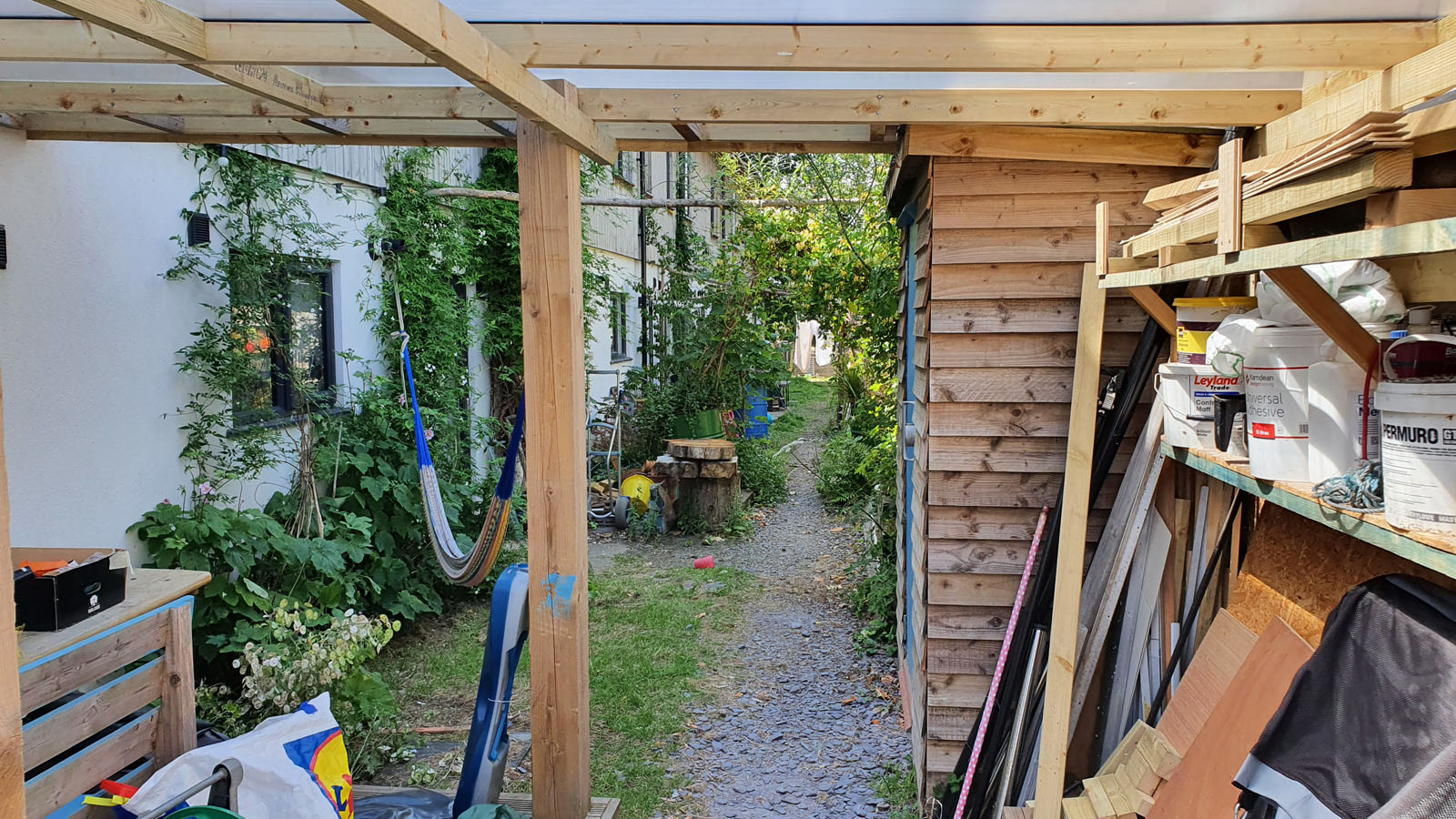
path across the shady rear gardensThere was no ‘common house’ or ‘intentional community’, but this looked and felt like intergenerational cohousing. The shady rear gardens also lacked fences. An informal path ran across and linked back doors where fences would have been. Individual and common spaces were blurred throughout the scheme, and reinforced our theory that community led housing is all about gardens.

A significant part of the project had been the requirement for residents to finish some of the internal fit-out of kitchens, tiling, and flooring, although no plumbing or electrical work was expected. Whilst this translated into a small additional equity percentage or rent discount, and allowed some customisation and a sense of satisfaction for residents, it’s main benefit seemed to be that residents got to know each other before they moved in.

This neighbourliness has persisted. If something needs fixing or doing, people know who to ask. This is informal, voluntary, friendly help, without written rules. Residents often meet to discuss mini-projects, to clear-out the shed, and add a green roof, and people feel free to express any issues they have.

What is interesting is the continuation of that culture over time. The first shared ownership sale took place last year. The new residents were not involved in the self-finish work, but have been welcomed into the community. Residents hope the same will be true of a rented home which recently became vacant.

Shared activities before people move in, sociable spaces, and a lack of fences, foster these relationships. These may only be small changes to conventional housing, but the value of children growing up in this way, the sense of belonging, knowing you have neighbours who can help, or casually leaving your front door open, are hard to value.
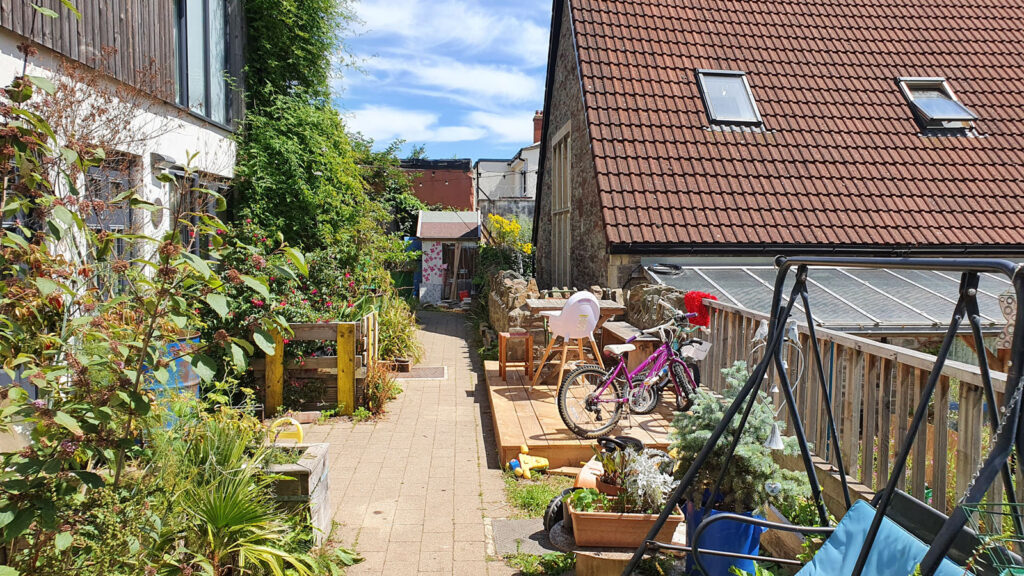
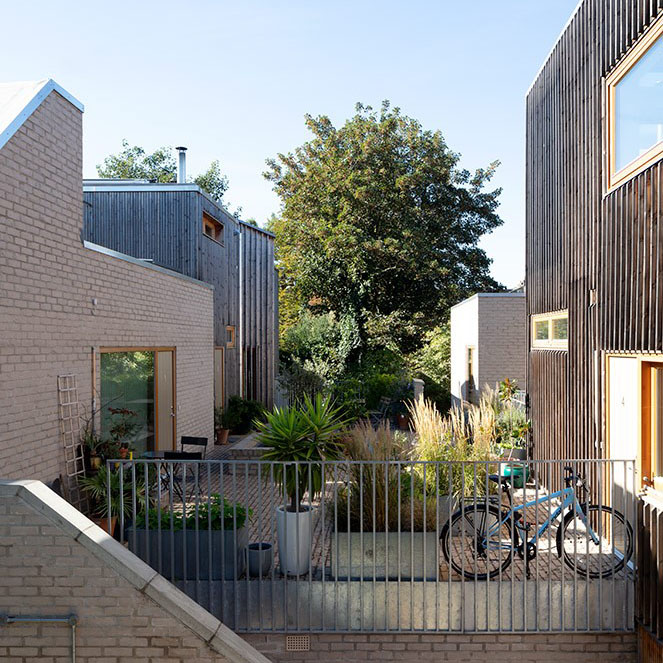
the relics of family life, barbeques, benches, bicycles

 
latest stories and opinion

Sociable Housing

8 September 2021

Our director, Levent Kerimol, joined a panel to discuss the scope for developers and councils to enable and integrate community led housing in their schemes, large or small.

The discussion took place on 8 September, and was organised by Jessica and Robert Barker from Stolon Studio and environmental psychologist Veronica Simpson, with Martyn Evans from U+I, Cllr Danny Thorpe and Cllr Anthony Okereke from RB Greenwich, and Stephen Haynes from LB Hackney.

Listen back to the full discussion here:

Lev is speaking from 0:47 mins onwards

 
latest stories and opinion

Doing Housing Differently

28 October 2020

All over London, people are coming together to take a leading and lasting role in delivering affordable, sustainable homes. This series of discussions explores how the principles underpinning the growing community led housing movement can be delivered at scale.

Join politicians, policy makers, developers, housing associations, financiers, industry experts and residents to examine the challenges and opportunities for shaking up the way housing is both developed and managed.

This is about residents partnering with industry to take control of the decisions that matter to them and developing viable housing models that are publicly supported, democratically controlled and with the benefits protected in the long-term.

Watch again, be inspired and gain an insight into how we can be Doing Housing Differently.

All sessions are now available to watch. 


KEYNOTE

Monday 16th November, 10:30

Tom Copley, Deputy Mayor for Housing and Residential Development

BUILD BACK BETTER

Monday 16th November, 10:50 – 12:00

What does better look like, not only in what we build, but in the way we own and manage our homes? How can community led approaches become a more consistent part of the London housing market?

with Tom Chance, National CLT Network; Lord Richard Best, Chair of the Affordable Housing Commission; Yolande Barnes, Chair of The Bartlett Real Estate Institute; Joe Wills, Centre for London

Watch Session


UNDERWRITING INNOVATION

Monday 16th November, 14:00-15:30

How can the public sector act entrepreneurially to create the conditions for investors and private lenders to fully fund community led housing schemes.

with Dinah Roake, RUSS; Mark Ogden, Triodos Bank; Liz Corrado, Collaborative Capital; Louise Leaver, Bevan Brittan LLP; Jonathan Schifferes, GLA

Watch Session


HOUSING ASSOCIATIONS ENABLING COMMUNITIES

Tuesday 17th November, 11:00-12:30

A detailed look at how housing association-enabled community led housing can work in practice in London.

with Linda Wallace, CDS Cooperatives; Abi Jacobs, L&Q Strategic Partnerships; Heather Thomas, Sapphire Independent Housing; Karen Cooper, G320 Housing Associations; Lorraine Podiephatshwa, Heads2Gether; Sanya Polescuk, NW3 CLT

Watch Session


RESIDENT EMPOWERED COUNCIL HOUSING

Tuesday 17th November, 14:00-15:30

Explore opportunities for community led approaches to empower social housing tenants and deliver sustainable housing models for London’s councils.

with Stephen Hill, C20 Future Planners; Andy Bates, Leathermarket JMB; Anne McGurk, Phoenix Community Housing; Cllr. Anthony Okereke, LB Greenwich; Hannah Emery-Wright, London CLT; Sib Trigg, PEACH

Watch Session


DEVELOPING FOR COMMUNITIES

Wednesday 18th November, 11:00-12:30

Learn how developers are working with communities to futureproof the social, sustainable and economic benefits of their schemes.

with Owen Jarvis, UK Cohousing Network; Frances Wright, TOWN; Olaide Oboh, First Base; Paul Clark, Stories; Sue Riddlestone, Bioregional

Watch Session


RECIRCULATING RENT IN CO-OPERATIVES

Wednesday 18th November, 14:00-15:30

A roundtable to explore how we can grow co-operative housing. What are the motivations to build new co-operative homes in London? and how can co-operatives support new affordable homes?

with Nic Bliss, CCH; Brockley Tenants Co-op; Sanford Housing Co-op; CASH; and Zahra Housing Co-op.

Watch Session

Putting Down Roots

12 September 2020

by: Levent Kerimol

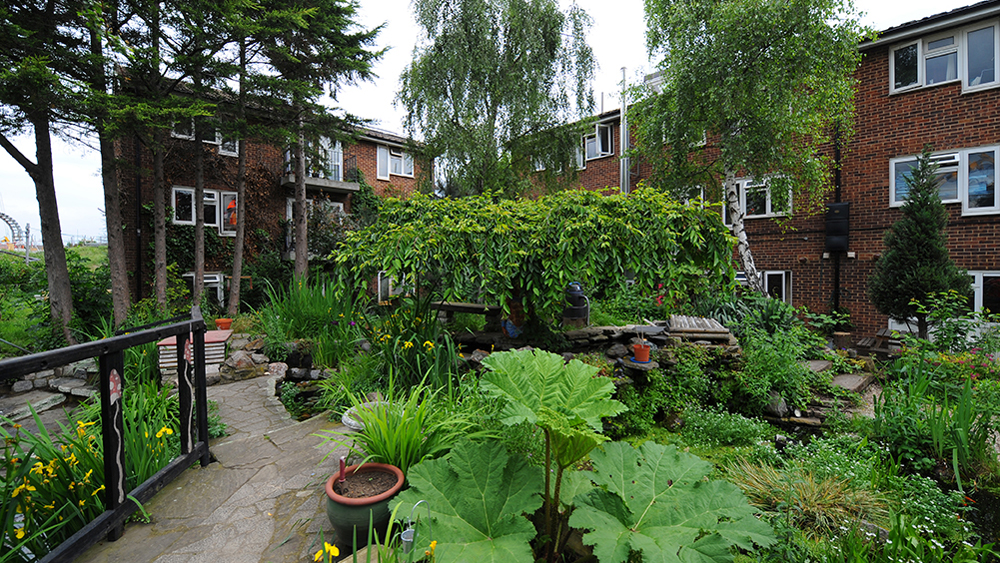
Our relationship to outdoor space has been very important during lockdown. But what if gardens were the key to understanding what makes community led housing unique?

Strangely, gardens may be more important than the housing itself.

Sharing amenities such as gardens is usually associated with cohousing. New Ground in Barnet has extensive gardens, and gardening is an activity that brings many residents together.

Copper Lane terrace - photo: Simon Henley
A shared terrace is at the heart of Copper Lane Cohousing

Copper Lane Cohousing residents share garden spaces and an outdoor terrace. Combining spaces makes them bigger than the ‘postage stamp’ each house would have had on its own and also gives a range of sunny and shady growing conditions for gardeners to experiment with.

Gardens often reflect the social and environmental ambitions of community led housing. Crystal Palace CLT formed from the local Transition Town group who run a number of food and growing community gardens – the next logical step is community housing. The Rural Urban Synthesis Society (RUSS) plans extensive community gardens on their Church Grove site to create a holistically sustainable neighbourhood.

Of course, many new developments feature areas labelled “communal/courtyard garden”, but these are often tentatively used, and rarely loved. London CLT’s St Clements housing was built by a developer to assumed expectations of household privacy and introversion. However an unexpected outcome of the Community Land Trust has been seeing neighbours of a pocket of CLT homes ignoring fences between gardens, to the extent their children think it strange when they visit friends houses that they can’t wander into other gardens. The openness to living closer with neighbours comes from the community engendered through the process before people move in.

There is often little in the architectural design of community led housing that differentiates it from other housing. Sanford Housing Co-op was the first purpose-built housing co-op and is typical of 70s social housing. However the gradual appearance of diverse and abundant gardens managed by residents provides a rich physical expression of community. These include ecological areas, food growing and a pizza oven.

Sanford Housing Co-op gardens
Shared gardens at Sanford Housing Co-op provide an expression of community

Even where existing terraced housing is taken over by community organisations, they are gradually changed by gardens that indicate these are not typical terraced houses. Brixton Housing Co-op owns a group of terraced houses whose back gardens form a shared urban oasis. Common ownership makes fences redundant. In Bonnington Square, lush tropical plants have spilled out to take over banal pavements (see image at the top of the page). This is an extension of the DIY guerrilla gardening attitude of the co-ops that emerged from squatted housing, and the common endeavour of campaigning to turn unused land into a pocket park for the neighbourhood, which is still managed by volunteers.

Perhaps gardens emerge where people feel settled and when they know their community. Community Land Trusts such as E16 CLT are motivated by allowing people to stay in their local area and put down roots despite rising prices and regeneration. Who knows what kinds of gardens will emerge?


Why not try our self-guided tour for Open House week, taking in the gardens that provide an expression of community, even if many buildings are not open due to covid.

You can hear from Sanford Housing Co-op, Crystal Palace CLT, and E16 CLT at our People Powered Homes event for London Open House in 2020.

Shared living in community ownership is different

15 June 2020

by: Levent Kerimol

When people are allowed to make decisions about how they want to live, they often confound conventional assumptions about how they ought to live. The cluster flats found in several European community-led housing schemes are one such example, that we can learn from in London.

With young people single for longer, families taking different shapes with increasing rates of divorce, and loneliness in older age, we know many households are far from the classic nuclear family with 2.4 kids. Yet conventional housing development continues to provide 2 or 3 bedroom units. Meanwhile institutional student accommodation or commercial “co-living” hangs hotel rooms from long corridors leading to shared kitchens as small as individual rooms, or other themed rooms accessed with a key card.

Community-led cluster flats blur the boundary between these two forms to create more sociable homes for a number of independent households, who may otherwise be confined to anonymous individualised living situations.

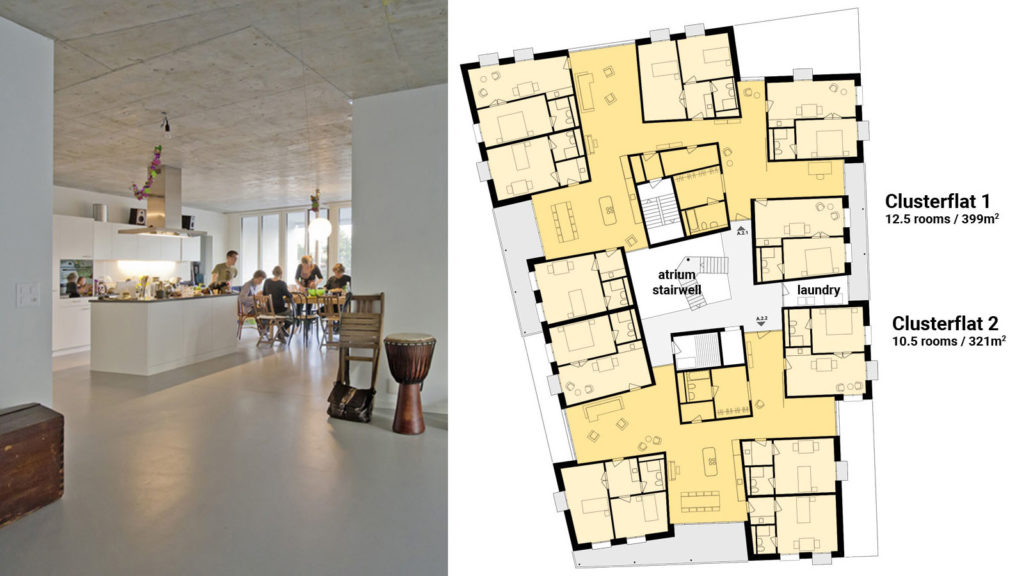
Mehr Als Wohnen (‘More than Living’) in Zurich has a block with generous atrium stairwells, communal laundry rooms shared by two cluster flats per floor. The cluster flats themselves include single rooms and suites informally placed across the plan, creating open-plan shared living, dining and kitchen spaces, as well as quieter corners. Each is it’s own community within the wider neighbourhood.

Merh Als Wohnen cluster flat example
example of cluster flats in Merh Als Wohnen

Kalkbreite, another ambitious co-operative development in Zurich, distributes cluster flats across floors, amongst more conventional flats. The communal corridor subtly changes into the shared hallway of a cluster flat, and cluster rooms have window into the hallway.

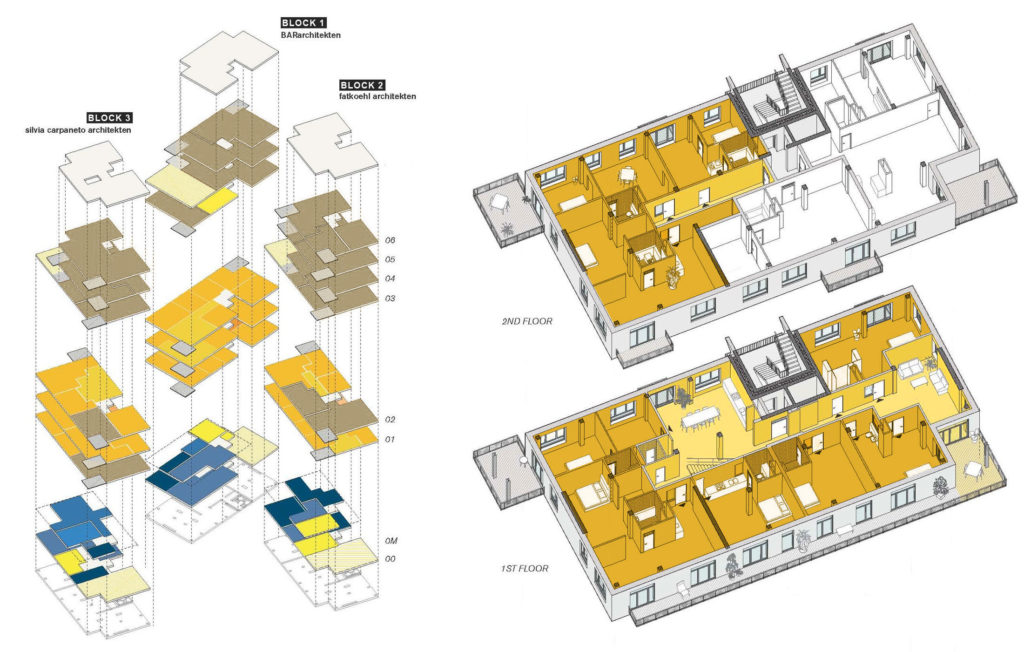
The Spreefeld Co-operative in Berlin integrates a cluster flat (orange) around more conventional flats (brown) within each of the three blocks that make up the scheme. The cluster flats are across several floors, and have their own internal staircases like a duplex apartments.

The individual clusters of rooms often have their own kitchenette and shower room, and may have a sitting room or two bedrooms, allowing parents and children their own space. These suites have normal internal doors rather than numbered flat entrance doors which are often left open as they lead into more private spaces only gradually.

In one cluster older people live with young couples, single parents and their children, as they find the social energy uplifting. Another cluster is formed of a group of older people who prefer a quieter home than living with noisy toddlers. These are communities with a sense of belonging and identity around their homes.

Spreefeld co-op in Berlin has a cluster flat in each block
Spreefeld co-op in Berlin has a multi-level cluster flat in each block

These schemes stand in contrast to branded commercial “co-living” developments. Residents are involved in the design process, set out their requirements and adapt their budget to the construction cost. This leads to subtle but important differences in physical arrangements. They can be considered small cohousing communities within community owned non-profit developments, rather than individual tenants providing the investor returns required by “co-living” operators, who make a virtue of fabricating a sense of community in order to charge inflated rents.

Of course, many of London’s private renters live in house shares, or “Houses in Multiple Occupation (HMOs)”. Shared kitchens, bathrooms, and living rooms, will not be something to aspire to. But their poor reputation is mostly due to lack of security and poor management by private landlords who seek to maximise their profits.

Shared living in co-operative housing is fundamentally different to co-living or privately rented house shares. You are your own landlord, together with all your neighbours or housemates. This means; control of when and how repairs get done, and taking responsibility for these costs, in a non-profit context.

Shared houses are frequently encountered in London’s co-operatives. Sanford Housing Co-op is largely made up of purpose-built houses for 8 single people with shared kitchen and living. Zahra Housing Co-operative wants to create multi-generational housing, where related households live under one roof.

The Drive Housing Co-op are a small intentional community who live together in a large Victorian house in Walthamstow and plan to build a new shared house in the garden.

HMO landlords and co-living often squeeze space standards and decent maintenance in favour of profit maximisation. A co-operative is in control of the choices and decisions they make, and can choose to make trade-offs between individual space and facilities for greater affordability and higher environmental performance.

  • Sitemap
  • Accessibility
  • Privacy
  • Disclaimer & Complaints

Copyright © 2026 Community Led Homes, part of the Co-operative Development Society

Registered: 17107R · 82 Tanner Street, London SE1 3GN · VAT no: 372 5329 48

Established by Mayor of London
Co-operative Development Society