• Skip to primary navigation
  • Skip to main content

communityled.homes

We support people making homes together through Cohousing, Community Land Trusts, and Housing Co-operatives

  • about us
  • projects
  • our support
    • collective ownership
    • build belonging
    • coproduction
    • community groups
    • councils
  • latest
  • contact

Levent Kerimol

Bridging the gap to unite the community in Newham

September 15, 2020

Mabel Amponsah is a board member of E16 CLT in Newham. She spoke to our Hub Co-ordinator Laura about how the CLT was set up and how she and other community members are working with the council to include a community-led approach to the regeneration of Custom House.


Unity in Custom House

Mabel is a resident of Custom House estate in Newham, where she has lived with her family for 10 years. Mabel was living in temporary accommodation in Newham when she found out about community organising initiative, PEACH (The People’s Empowerment Alliance for Custom House). She was dealing with rent and repairs issues and tells me “I spoke to a lot of neighbours around because we are like a unit in the area.”

Mabel (pictured) has been working with PEACH for six years as a volunteer. When working working there, the community came up with the idea of a proposing an alternative to the Council’s own regeneration plan.
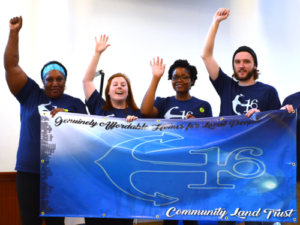
She told her neighbours, “I think we need to have our voices heard and to give it a try.”  Working with architects, community organisers and local residents, they put together a plan for how they want to see the future of Custom House.

As part of this plan, they came up with the idea of creating a Community Land Trust to own and manage homes in the regeneration. Mabel and other community members came together and did lots of research and realised, “oh wow, there’s an opportunity for us to start a legacy, especially with high rates of poor housing and poor living conditions and so on, and so it is time that the community takes control back of their housing situation.”


Having done the research, they didn’t know how they would bring their ideas to life, but a visit to Brighton CLT helped to see how these ideas could be real. “We actually travelled to Brighton and we saw their model, which was quite something for me. It brought reality home.” They saw it was possible and decided to set up their own CLT at Custom House.


What does community mean to you?

“The community is a family to me,” Mabel tells me, “it’s where you communicate, you share issues, you bring up common interests that need to be resolved. You work together as a team; you empower each other – you build those skills that someone may lack.”

For Mabel, the community is a “collective of different people who are coming together for the best interests of the area that they live in.”

Through the work the CLT have done developing their own ideas, Mabel and other community members have gained a lot of insight into the world outside their own circle of family, home and workplace.

E16 CLT is united and organised but Mabel tells me that they also have “ups and downs and challenges – it’s never a smooth thing!”


What does the future hold for E16 CLT?

“The future hope is that we will be able to work hand in hand with Newham Council, to acquire land and to build properties which will be led by the community.”

Mabel tells me that there are “two sides of Custom House – my side I would say is the lower economy class, but when you go over the bridge, you have all these hotels and you feel like you’re in a different part of the area.”

Mabel senses there is an opportunity from the ExCel centre being so close. “If people from around the world are coming in to our borough and especially our local area, bringing something positive, how come we the residents don’t know what’s going on?”

For Mabel, these two worlds “need to learn how to work together”.

Mabel sees a future where the bridge does not create a divide between two communities, where house prices and school choices aren’t so different, but a future where the bridge unites the two communities of Custom House.

Mabel believes E16 CLT can create one unified, diverse community where people’s life chances and opportunities are the same. “With the community coming together, we can bridge the gaps in society.”


How will E16 CLT achieve that bridging of these two worlds?

“The CLT has done a lot of work talking to people in the community one to one, we’ve had interviews, we’ve run workshops, where people have shared their ideas of the type of community they want to see.” They have then been able to relay those ideas to the council so that they can be taken on board.

It is early days, but they are hoping that the time taken to share these ideas and educate themselves through things like site visits, has meant that they will have more influence with the council going forward.

“A good relationship with the council is what is going to make that transition, in terms of not feeling that difference between one side of Newham to the other.”

Telling me about working together as a team at E16 CLT, Mabel explains, “It’s hard work” but she believes “it’s all about communication, trust, relationship building, working together, understanding each other, being open and honest about what is going to get us there.”


Interesting times at E16 CLT

It’s a busy time for the CLT Mabel tells me. “We are doing a feasibility study for CLT homes in Custom House”.  “We are also in contact with the regeneration team of Newham Council, communicating with them about how we can use those areas in the meantime whilst the regeneration is going on and how they can support us to acquire the land.”

“The most exciting thing,” she tells me “is that the relationship with the Council has become much stronger. We have more energetic, lively, vibrant people with more to offer.”

Now the Council have agreed to work with E16 CLT, this feels like the most exciting development so far. “We are working in partnership, not working against each other.”

Mabel is very determined that there will be no difference between the look of the private sector developments, social housing or the community led schemes. The idea of coherence and feeling part of one big community which is unified and diverse is crucially important to the CLT.


What are the next steps for E16 CLT?

Mabel tells me there will be the CLT’s third AGM for members at the end of September which “is a real achievement” to get this far.

Another big step is negotiating with the council over the management of some empty homes in the area. Mabel tells me E16 CLT is looking to take on some “empty council properties and manage them to become a community landlord.”
She tells me she believes there are 10 properties that the Council may allow them to manage. There is a lot to do to prepare for this step, such as agreeing an allocations policy and repairs strategy.

The CLT will also be able to set the rents and the security of the tenancies for these properties. Mabel explains that currently her rent is 75% of her income and so it is impossible for her to save up to buy her own home and feel more secure in her tenancy. The fact that the CLT can give people like her, that security will be completely life changing.


How has CLH London benefitted E16 CLT

CLH London has helped E16 CLT in a number of ways. Mabel tells me the key things were “learning all about CLTs in the beginning and how to recruit new members”, and that with the help of CLH London “we’ve revisited our code of conduct to help with recruitment”. There has also been help with the website and social media so that E16 CLT could recruit new members and publicise their work.

Mabel explains that if they had been trying to do this on their own they would have missed out on many partnership opportunities and chances to learn from other groups about how to set up and run their CLT.

There is a lot to learn , but “no matter what faces us, good or bad, we have that support, we have got that encouragement, that empowerment, to push us on and we don’t give up.”

Knowing that the future of the CLT is bright, Mabel tells me “it gives you all the hope to know that it is possible, we are not alone.”


Have you got an idea for a community led housing project in London?

To learn more about the kinds of support available, visit our support page, sign up to our mailing list or follow us on Facebook, Twitter and Instagram @CLHLondon to find out about upcoming events and training.

Putting Down Roots

September 12, 2020

by: Levent Kerimol

Our relationship to outdoor space has been very important during lockdown. But what if gardens were the key to understanding what makes community led housing unique?

Strangely, gardens may be more important than the housing itself.

Sharing amenities such as gardens is usually associated with cohousing. New Ground in Barnet has extensive gardens, and gardening is an activity that brings many residents together.

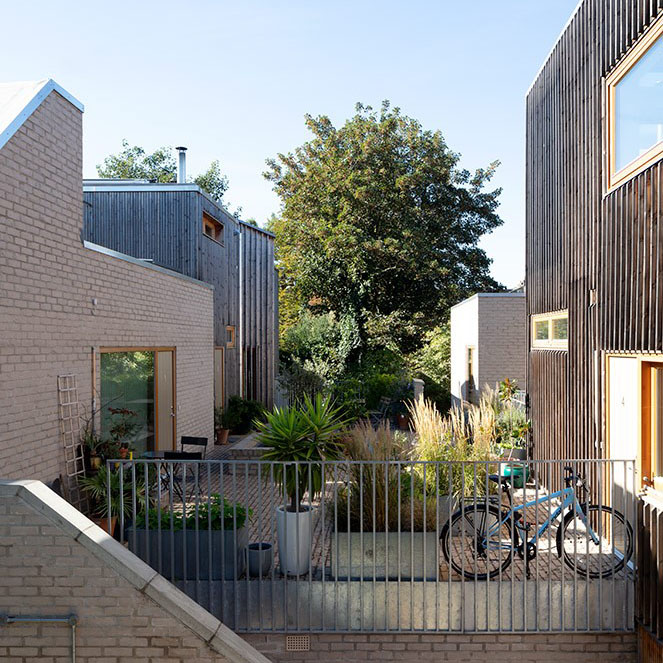
Copper Lane terrace - photo: Simon Henley
A shared terrace is at the heart of Copper Lane Cohousing

Copper Lane Cohousing residents share garden spaces and an outdoor terrace. Combining spaces makes them bigger than the ‘postage stamp’ each house would have had on its own and also gives a range of sunny and shady growing conditions for gardeners to experiment with.

Gardens often reflect the social and environmental ambitions of community led housing. Crystal Palace CLT formed from the local Transition Town group who run a number of food and growing community gardens – the next logical step is community housing. The Rural Urban Synthesis Society (RUSS) plans extensive community gardens on their Church Grove site to create a holistically sustainable neighbourhood.

Of course, many new developments feature areas labelled “communal/courtyard garden”, but these are often tentatively used, and rarely loved. London CLT’s St Clements housing was built by a developer to assumed expectations of household privacy and introversion. However an unexpected outcome of the Community Land Trust has been seeing neighbours of a pocket of CLT homes ignoring fences between gardens, to the extent their children think it strange when they visit friends houses that they can’t wander into other gardens. The openness to living closer with neighbours comes from the community engendered through the process before people move in.

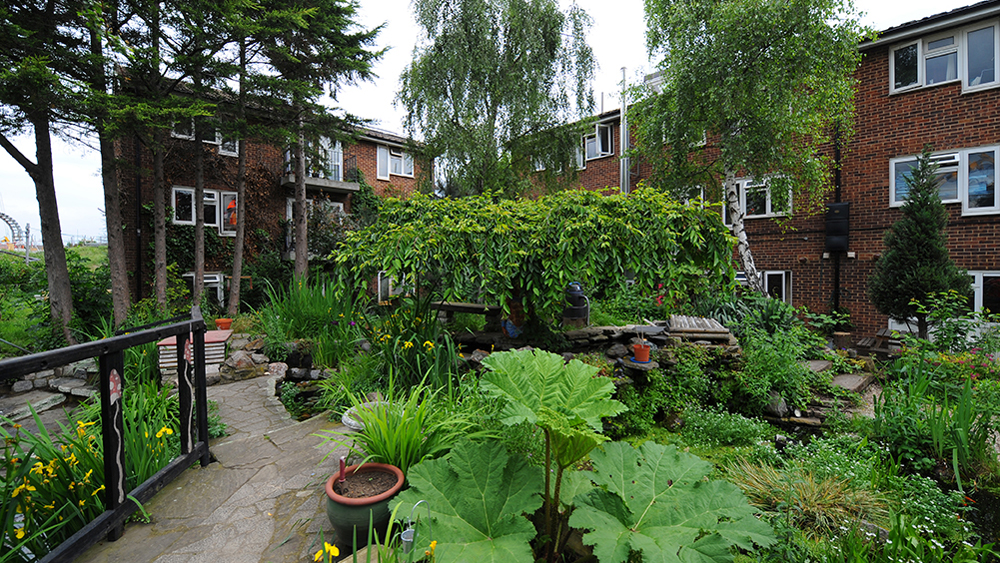
There is often little in the architectural design of community led housing that differentiates it from other housing. Sanford Housing Co-op was the first purpose-built housing co-op and is typical of 70s social housing. However the gradual appearance of diverse and abundant gardens managed by residents provides a rich physical expression of community. These include ecological areas, food growing and a pizza oven.

Sanford Housing Co-op gardens
Shared gardens at Sanford Housing Co-op provide an expression of community

Even where existing terraced housing is taken over by community organisations, they are gradually changed by gardens that indicate these are not typical terraced houses. Brixton Housing Co-op owns a group of terraced houses whose back gardens form a shared urban oasis. Common ownership makes fences redundant. In Bonnington Square, lush tropical plants have spilled out to take over banal pavements (see image at the top of the page). This is an extension of the DIY guerrilla gardening attitude of the co-ops that emerged from squatted housing, and the common endeavour of campaigning to turn unused land into a pocket park for the neighbourhood, which is still managed by volunteers.

Perhaps gardens emerge where people feel settled and when they know their community. Community Land Trusts such as E16 CLT are motivated by allowing people to stay in their local area and put down roots despite rising prices and regeneration. Who knows what kinds of gardens will emerge?


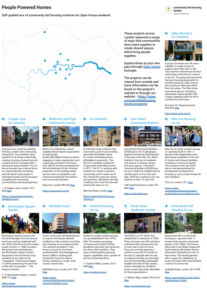
Why not try our self-guided tour for Open House week, taking in the gardens that provide an expression of community, even if many buildings are not open due to covid.

You can hear from Sanford Housing Co-op, Crystal Palace CLT, and E16 CLT at our People Powered Homes event for London Open House in 2020.

Open House self-guided tour

September 3, 2020

As part of Open House week we have prepared a self-guided tour for you to visit community led housing projects and shared garden spaces in London.

Download the pdf and make your own way around these schemes viewing the places that communities have created together. Please note you will only be able to view projects from public areas due to covid precautions.

People Powered Homes: A Manifesto

August 24, 2020

On the 10th August, Rowan Mackay, our Senior Project Adviser, spoke at an event hosted by New London Architecture.

The event was entitled Build Back Better and the speakers were presenting ideas of how the future of architecture could be in response to the pandemic and other crises we currently face.

Rowan spoke about a manifesto for community led housing offering a valuable alternative to the mainstream and he has recorded his presentation, sharing ideas and inspiration with our community.

Building affordable homes for single parents in south London

August 18, 2020

Our coordinator, Laura had the chance to talk with Lorraine Podiephatshwa, a member of Heads2Gether to hear about their plans to build affordable homes for single parents in South London. Lorraine tells us what the inspiration was for the group and how they have worked together to achieve it.


Lorraine is on a mission to build affordable homes for single parents in London

Lorraine moved to Croydon in 2006. A hard-working single mother, she has since moved from place to place, experiencing a succession of private and council landlords along the way.

“At one point, I was technically homeless,” she tells us. “I was living in emergency accommodation and I was so frustrated by the living conditions.”

That led her to look for alternative housing options online – and that was where she discovered community led housing.

“As soon as I found it, it caught my attention. The stories were of ordinary people – with no experience, no skills and no money – setting up groups, gaining funding and building homes for themselves.”

Driven by the idea of having a place to call her own and living with like-minded people, Lorraine decided to start her own housing cooperative: Heads2Gether.


Heads2Gether gets a head start

Lorraine (pictured below, third from left) explains, “At first, we were a small group of single parents, living and working in Croydon. What brought us together was the idea of creating a safe community for our children, while living in affordable homes.”

The group’s first step was to contact the Community Land Trust Network for advice.

“I remember the first thing I asked them was… ‘is this actually real?’ I thought the whole thing sounded too good to be true. They replied and said, ‘yes, of course it’s real!’”

With a new understanding of community led housing, Lorraine then contacted us at Community Led Housing London.

“The first person I met was Gemma.” Lorraine says. Gemma was a Senior Project Adviser at CLH London until 2021. She advised groups across London on how to organise, as well as how to find a site and finance construction.

Gemma advised Lorraine to get the word out about her idea and find others in her community that wanted to join her.

Meanwhile, the CLH London team started to put together a workshop in order to help Heads2Gether… well, put their heads together.

“I reached out to other women who were living in temporary accommodation,” Lorraine explains. “Many of them, like me, didn’t believe community led housing was real at first! They were saying, ‘where are ordinary people like us going to get all the money we need to build?’”

“All I said was, ‘come along to this meeting and find out what’s possible.’”


How CLH London helped start their journey

The first time they attended a workshop, Heads2Gether made a big impression.

Lorraine remembers that session fondly: “The CLH London team were very honest with us and told us everything we needed to know. They took us through all the challenges and complexities and were very open about it taking some time – not least because we would have to educate ourselves along the way.

“Sadly,” Lorraine continues, “some of the people at that first meeting thought it was too much for them and dropped out.”

Luckily for the group, Lorraine herself wasn’t put off by this initial setback. In fact, she tells me she became more motivated than ever and continued to educate herself by reading about community led housing online.

Six months later, when we reached out to Lorraine again, she was much more clued-up than before.


The first viewing – and the first challenge

And why were we reaching out? To tell Lorraine that Croydon Council were setting up meetings with community led housing groups to learn more about their projects – and to take them to see potential sites.

“At this meeting, the inspiration and motivation really started to set in,” she tells me.

Soon after, she and other members of Heads2Gether were invited to view several sites. “This was the first time we’d been invited to view sites, and people were starting to feel like the project finally had credibility. They were saying, ‘oh, this is real, this is happening!’”

Finding a site is one of the greatest challenges a community will face. For Heads2Gether, it was important to find land that was spacious enough, with good access to amenities such as schools.

Heads2Gether’s first bid – on a site in Upper Norwood – was unsuccessful, and the land instead went to another team who had also been working with CLH London, Crystal Palace Community Land Trust (CPCLT).

“But we didn’t let it stop us,” says Lorraine. “We decided to take it as a learning experience.”

This Lorraine most certainly did – she tells me she went to shadow meetings at CPCLT, to pick up ideas and inspiration and to learn all the things they did right!


Finding a place to call home

Despite the early setback, Lorraine is still confident Heads2Gether will find their perfect site.

I asked her, what’s her secret to staying motivated and keeping the momentum going?

“My motivation is my frustration,” she admits. “I have lived in rented accommodation ever since coming to London, and it’s not what I want for my future.”

“Many members of Heads2Gether also live in rented accommodation. They find it almost impossible to afford,” she says.

“I want to be in control of my own home. I want to be able to decide where I live, and I want to have a community around me to offer mutual support,” she says. “I don’t want to keep living in rented accommodation.”


A truly affordable alternative

This, Lorraine says, is why she believes in community led housing. It offers a truly affordable route out of the rental cycle.

When it comes to finding funding for the project, Lorraine says the support and expertise available through Community Led Housing London has been invaluable.

“Up to now, we haven’t spent any of our own money,” Lorraine explains.

“And when we were writing our proposal for the Croydon site, CLH London connected us with architects and helped us with the financial model.”

For Lorraine, for whom rent is already a huge expense, this is one of the greatest benefits of working with CLH London.


How Community Led Housing London is giving Heads2Gether knowledge and confidence

“If CLH London wasn’t there, I don’t think we’d be where we are now,” Lorraine tells me.

“From choosing a site, to applying for funding, they’ve helped us and offered all sorts of training. CLH London has always been there to support us.”

I ask Lorraine, what has been the greatest benefit of having CLH London there to guide her on this journey?

“The greatest benefit,” she replies, “is that now we, as a community, feel we can dive into any challenge – we don’t need to be afraid that we won’t know how to do something, because we can always rely on CLH London to guide and support us.”

I ask her what she would recommend to other first-timers and she tells me, without hesitation, “You must have passion, you must know why you want to embark on this journey. If you don’t have a drive, if you don’t have passion, you will be put off by the challenge.”

But, she says, the rewards make the hard work worthwhile. Lorraine has found a great sense of fulfilment from her journey – developing new skills, meeting new people and finding a route to housing that gives her great satisfaction.

“I’m loving it. It’s my opportunity to give back to my community. This is my legacy.”

“I believe once we get our site and start building, this will all have been worth it. Until then, we will keep doing one thing at a time.”


Have you got an idea for a community led housing project in London?

To learn more about the kinds of support available, visit our support page, sign up to our mailing list or follow us on Facebook, Twitter and Instagram @CLHLondon to find out about upcoming events and training.

latest stories and opinion

  • Sitemap
  • Accessibility
  • Privacy
  • Disclaimer & Complaints

Copyright © 2025 Community Led Homes, part of the Co-operative Development Society

Registered: 17107R · 82 Tanner Street, London SE1 3GN · VAT no: 372 5329 48

Established by Mayor of London
Co-operative Development Society